
Serving Others Leads to Personal Growth
Building More Than Porches Through Grace House
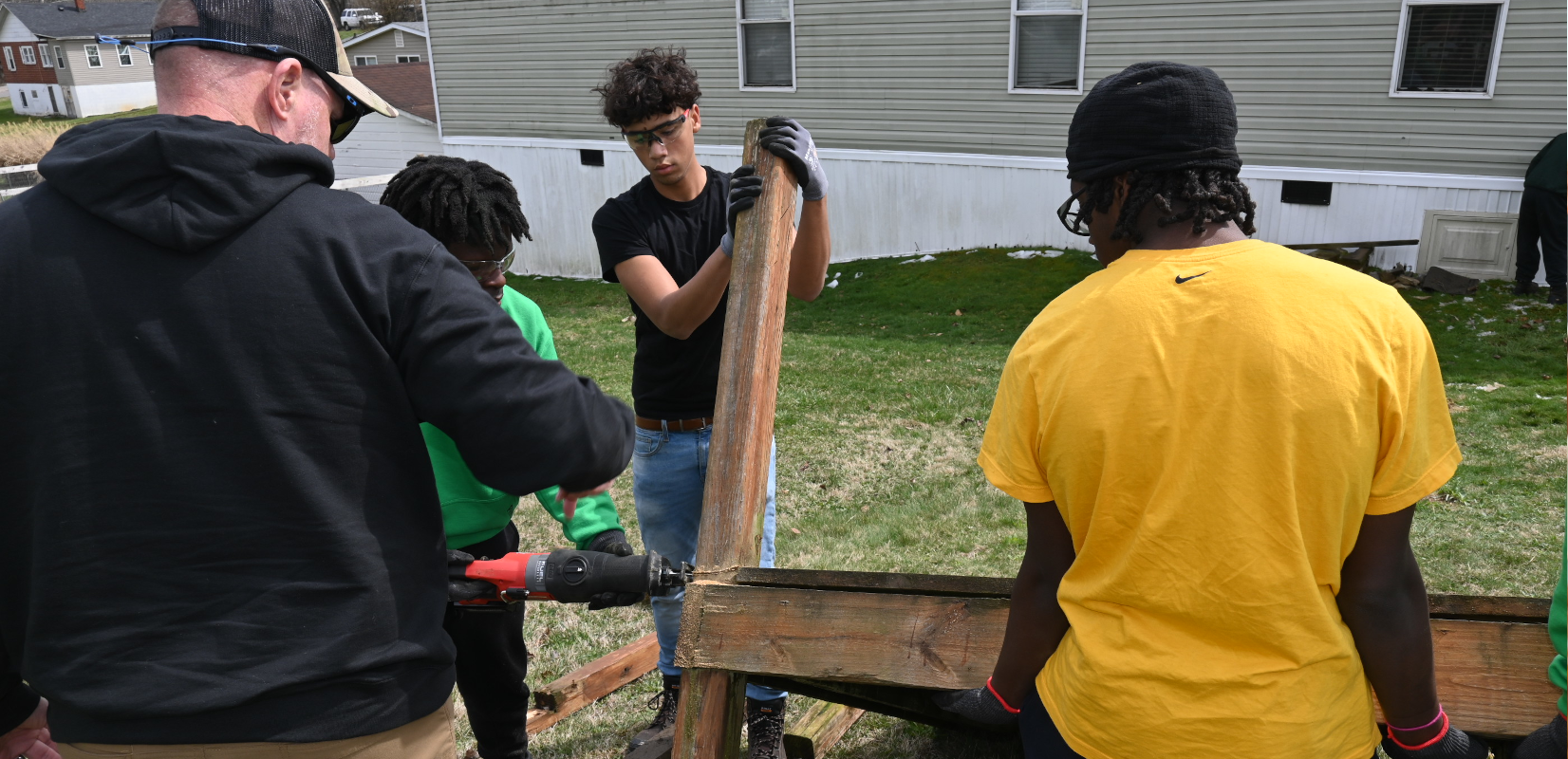
Seven students from our Boys Home Trades Program headed out on an early spring morning with hammers, saws, and zero idea how much the day would change them. They were driving to Grace House on the Mountain, a ministry center of The Episcopal Diocese of Southwestern Virginia in Wise County, where they’d spend the day rebuilding a crumbling porch for Christine, a woman in her late 70s who was choosing between paying her water bill and buying food.
Grace House has been doing this work for over a century, helping families in the surrounding community have safe, warm, and dry homes, and connecting people with essential services like electricity, water, and medicine when they can’t afford them on their own. For the Boys Home students, it was their first time partnering with Grace House, but they were about to learn what the ministry has known all along: sometimes the people doing the serving end up changed just as much as the people being served.
When they arrived, the porch they found was barely standing, with boards hanging loose and the whole structure looking as though it was ready to collapse at any moment. But for Christine, this was something she needed; it was her emergency exit if something went wrong in her home.
But by the end of the day, the students had already torn down the old porch and built a new one. And what they found inside themselves mattered even more.
Stepping Out of the Comfort Zone

For Matt Dillon, who had only been at Boys Home for about a month before embarking on this Grace House trip, this is what he described.
“The Grace House trip was an amazing experience. I’ve grown a lot from being in the trades. During my time there, I stepped out of my comfort zone and learned how good it felt working with my peers to make a difference.”
The phrase, ‘stepping out of my comfort zone,’ sounds effortless, but it’s quite a courageous thing to do. The students didn’t just show up at her door and hand her money to solve her porch issue. They got their hands dirty, worked alongside adults and each other, and figured out problems in real time.
Research shows this kind of hands-on service work does something unique for adolescent boys. Volunteering is linked to higher grades, stronger academic motivation, better school engagement, and improved leadership and social skills, but the benefits go deeper than grades.
When teens help people in need—tutoring younger kids, caring for elderly neighbors, building something useful—they develop empathy, see the world from someone else’s perspective, and begin to understand that their own struggles fit into a much bigger context.
The Youngest One Led the Way

Jase, a sixth grader who’d just turned 13, was the youngest student on the trip, and at one point during the project, there were too many people and not enough tasks for everyone. Some students might have used that as an excuse to stand around, but Jase didn’t.
“At times, there were probably too many people for the project, between seven students and three adults,” Donor Relations Manager, Laura Costigan, who organized the trip, recalls. “But Jase took it upon himself because he didn’t like just idly standing there.”
While others waited for direction, Jase found work, stayed busy, and contributed however he could. That’s leadership—not the loud, flashy kind, but the quiet, steady kind that notices what needs doing and does it without being told.
Learning What Growth Really Looks Like
Shiloh Cuyasse had been at Boys Home about as long as Matthew—just a few weeks. But in that short time, the Trades Program had already started shifting how he saw himself and the world.
He wrote:
“As my life has gotten longer, I have not grown just physically, but I’ve started to think from other people’s perspectives. Grace House helped me with that. When I saw the lady everyone was building it for, I thought of my grandma. Instead of feeling tired or bored on the job, I felt good and content in my heart.”
Think about that for a second—a teenager who admits he used to think mostly about himself now thinks about his grandma when he sees an elderly woman struggling, and he feels “content in my heart” doing hard work for someone else. That’s not a small shift. That’s the beginning of becoming the kind of man who makes the world better just by being in it.
Shiloh kept writing:
“Overall, this experience helped me become more responsible, content, and thoughtful. I learned that growth doesn’t just happen in the classroom; it happens in real-life experiences where you step out of your comfort zone.”
Why Service Work Matters for Young Men

There’s a reason Boys Home prioritizes these kinds of trips, and research consistently shows that adolescents who volunteer regularly show higher self-esteem, lower rates of depression, and better overall psychological well-being. Some studies even found that teens who volunteer have lower cholesterol and blood pressure compared to those who don’t.
But beyond the measurable health benefits, service work helps young men find purpose and answers the question every teenager asks at some point:
Does my life matter? Am I making a difference?
“We built a porch for an elderly woman,” Matthew wrote. “During the trip, after dinner, we had a Christian devotion. It gave me time to reflect on my faith and grow closer to God, helping me understand my surroundings. Overall, this experience didn’t just impact the people we were serving—it changed me too and helped me become a more thoughtful and caring person.”
The Lesson
Laura Costigan spent weeks getting the Grace House trip ready—everything from coordinating with Christine to organizing the students and transportation, and, of course, making sure everyone had everything they needed for a successful trip!
But the physical act of building the porch wasn’t the point. What she wanted for these young men was to come away from the experience seeing their lives differently.
Laura said, “I was trying to make sure the young men understood—there are a lot of people out there who are put in these difficult positions where they have to choose between being able to buy food and being able to pay their water bill.
Meanwhile, there are people out there who cannot cover their basic needs. And that’s a really tough lesson for anyone to grasp, especially for teens who are working through their own problems.
These experiences help our young men to internalize that wherever life takes them on their own journey, they can always find a way to help others.
What’s Next for Grace House

The Grace House partnership is growing, with two more trips planned for June: one for middle school students and one for high school students, and there’s talk of adding a fall project too, in partnership with the youth of the Episcopal Diocese of Southwestern Virginia.
Jody Eggleston, who leads the Trades Program, wants to make sure future trips have enough work for everyone to stay engaged.
Last year, they built a wheelchair ramp for a man who couldn’t leave his home without it; this year, a porch; and next time, maybe something even bigger.
The work the Boys Home students are doing isn’t really about the size of the projects, but the growth of the students. When we give our young men a real chance to serve, they are building character, empathy, and the kind of lives that matter.
At Boys Home, we call this “Exit to Serve”—the idea that students aren’t just here to get something for themselves, but to become the kind of men who give back to their communities.
Want to learn how Boys Home of Virginia combines hands-on skill development with character and service? Connect with us today to discover our whole-person approach to educating young men so they can thrive.