
A Bishop's Full-Circle Journey Back to Boys Home of Virginia
From Childhood Memory to Board Member: Bishop Karin's Story
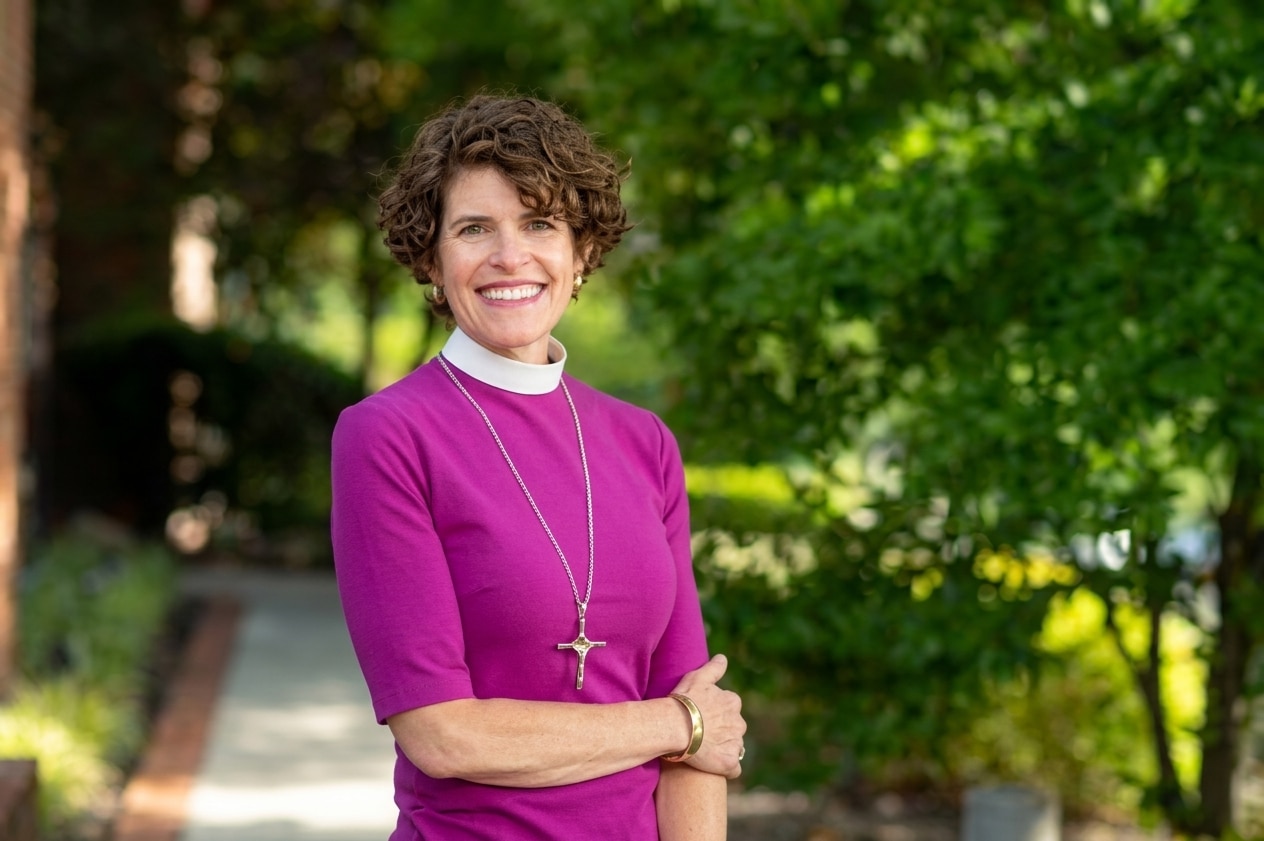
Bishop Karin MacPhail didn’t expect her connection to Boys Home of Virginia to feel like coming home. But sitting in the dining hall during a recent board visit, surrounded by the easy noise of boys laughing over lunch, something clicked into place that she hadn’t seen coming.
“It was this little glimpse of heaven to me,” she says. “People making a family and caring for each other beyond biological family.”
It wasn’t the first time she’d experienced something like it. Long before she became Bishop of the Episcopal Diocese of Southwestern Virginia, before she was even ordained, Karin spent her earliest years living on the grounds of a children’s home where both of her parents worked.
She rode the school bus with the kids who lived there and ate family-style meals at long tables with children who’d been placed there for reasons no child should have to carry. Those kids were her first playmates, and later, teenagers were her first babysitters.
Decades later, watching two Boys Home students talk and laugh through lunch, that memory came rushing back. “I just remembered it was this little flashback to being seven years old,” she says, “sitting at a table just like that… a family that looks different than the family that I made on my own, but there’s this beauty and uniqueness to it.”
A Long Road to This Role
Karin’s connection to Boys Home started well before her election as Bishop. As rector of St. Elizabeth’s in Roanoke, she watched her congregation build a real relationship with the school. St. Elizabeth’s took up collections for sports equipment and uniforms, welcomed students and staff to speak at services, and made the trip out to see the campus for themselves.
By the time she was consecrated Bishop in June, that relationship had already shaped how she thought about her new role. Now she sits on the Boys Home Board of Trustees, one of the many hats she wears across a diocese of fifty churches.
Her focus there is specific: helping preserve the school’s Episcopal identity and values, from chaplaincy to Christian formation, while making sure Boys Home stays open and welcoming to young men of every background.
One shift stands out to her. In recent years, Boys Home students have gone from being treated as a separate group the diocese supports, to full participants in diocesan youth ministry events and leadership. Research on adolescent faith development backs up why that shift matters.
When young people are invited into real leadership roles within a faith community, rather than kept at arm’s length, they report feeling more invested and are more likely to see themselves staying involved over the long term.
Karin has seen that play out firsthand, and she’d like to see it go further still. “I’d love to see some of them even become part of the youth ministry team and be leaders in that group,” she says.
What She Sees When She Visits

At her most recent board visit, Karin sat down to lunch with two students who, in her words, were “so talkative and open and funny.” She also reconnected with a young man she’d known for years through the diocese, someone she knew had struggled in school before coming to Boys Home. What she noticed was a level of confidence and belonging that hadn’t been there before.
“It doesn’t have that sense of, I think there could be a perception for people who don’t know Boys Home that you get sent there if something’s wrong,” she says. “It very much doesn’t feel that way.”
One detail from that visit has stuck with her: the students told her how peaceful Boys Home felt compared to what they’d known before. That sense of calm isn’t incidental.
Research on adolescent development has found that daily experiences of connection and belonging, including through faith and community, are linked to lower anxiety in teenagers.
For students arriving at Boys Home from unstable or difficult circumstances, that quiet may be doing more than it seems.
Looking Toward What's Next
Karin is especially energized by where Boys Home is headed. She points to the expansion of vocational education, alongside traditional academics, as something she finds genuinely remarkable. “The idea of having a tuition-free boarding school focused on vocational education is mind-blowing in the best way,” she says.
Farming, welding, mechanics: paths that don’t always get the same spotlight as college prep, but that give plenty of young men purpose and a real future.
She’s also watching closely how Boys Home is investing in the people who make the mission possible day to day.
She has real admiration for Executive Director Chris Doyle and his wife Katherine, and for the staff who show up for students in ways that aren’t always easy. “It takes a special kind of dedication and strong sense of purpose,” she says.
When asked what she’d tell a family considering Boys Home, her answer comes without hesitation: visit, see it for yourself, and know that this is a place filled with love. “It’s not a reform school,” she says.

For Karin, that’s not just an outsider’s hope for Boys Home. It’s something she recognizes, because in a different form, in a different decade, she lived it first.
Curious what a Boys Home education could look like for your son? Contact us to schedule a visit.